
Cervical Cancer: Why I Count Years, Not Scars
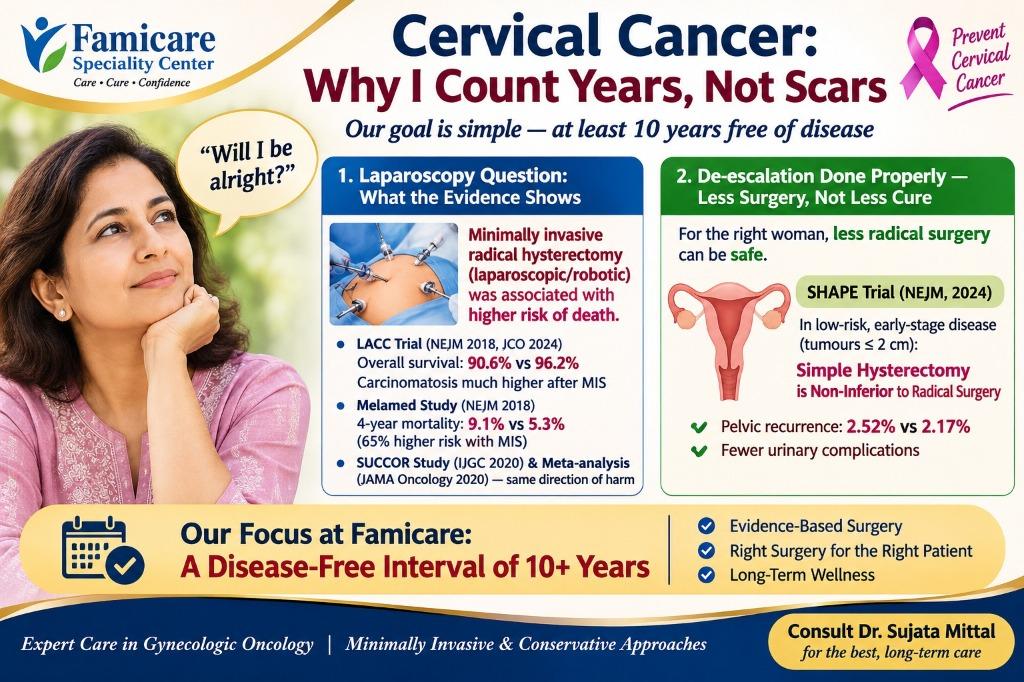
Every woman who walks in with a cervical biopsy asks: "Will I be alright?" For decades, surgical debates fixated on incision size. Here is why true oncological excellence is judged by a disease-free interval of 10+ years, backed by landmark clinical trials.
Key Takeaways
- The primary metric of success in cervical cancer surgery is long-term, disease-free survival (10+ years), not cosmetic incision size.
- Landmark phase 3 clinical trials (LACC, Melamed, SUCCOR) demonstrated that minimally invasive radical hysterectomy carried higher recurrence and mortality risks compared to open surgery due to tumour spillage from uterine manipulators and unprotected colpotomy.
- Surgical de-escalation must be evidence-guided: The SHAPE trial (NEJM 2024) proves that for low-risk early-stage tumours (<= 2 cm), simple hysterectomy offers equivalent cure rates with significantly fewer urinary complications.
- Selecting the right surgery for the right patient guarantees the highest probability of cure and quality of life.
Every woman who walks into our clinic with a cervical biopsy report asks some version of the same question: "Will I be alright?" She rarely asks how long the incision will be, or whether the surgery will be done through a keyhole or an open cut. Yet for nearly two decades, that was the question the surgical world argued about — and, as it turned out, we were arguing about the wrong thing. At Famicare, we have organised our entire cervical cancer practice around one central number: the disease-free interval. Not how modern the equipment looks or how small the scar appears. When I accept a patient for cancer surgery, I am selecting for a realistic prospect of ten or more years completely free of disease.
1. The Laparoscopy Question: What the Randomized Evidence Actually Showed
For years, minimally invasive radical hysterectomy — whether laparoscopic or robotic — was assumed to be as good oncologically as open surgery, with the bonus of less pain, less blood loss, and a faster hospital discharge. Retrospective series supported this. International guidelines permitted it. For many centres across the world, it became the unexamined default. Then the rigorous randomised prospective data arrived, and it was deeply sobering:
- The LACC Trial (NEJM, 2018; Final Analysis, JCO, 2024): This landmark international phase 3 RCT randomised 631 women with early-stage cervical cancer to either minimally invasive or open radical hysterectomy. The trial was halted prematurely by the independent data safety monitoring committee due to a statistically significant excess of recurrences and deaths in the keyhole arm. Overall 4.5-year survival was 90.6% in the minimally invasive arm versus 96.2% in the open surgery arm. Strikingly, peritoneal carcinomatosis was far more frequent after keyhole surgery, confirming tumour cell spillage during laparoscopic manipulation rather than biological bad luck.
- The Melamed Study (NEJM, 2018): Published alongside LACC, this extensive epidemiological analysis of the US National Cancer Database evaluated thousands of patients and identified a 4-year mortality of 9.1% after minimally invasive radical hysterectomy versus 5.3% after open surgery — representing a staggering 65% higher risk of death.
- The European SUCCOR Study (IJGC, 2020): Auditing 126 institutions across 29 countries in stage IB1 cervical cancer, SUCCOR found significantly higher relapse and mortality rates with minimally invasive surgery. Crucially, the researchers identified the root mechanical culprits: the intracervical uterine manipulator and unprotected vaginal colpotomy under pneumoperitoneum.
- The Comprehensive Meta-Analysis (JAMA Oncology, 2020): Encompassing 15 methodologically rigorous observational studies and 9,499 women, the meta-analysis reinforced the exact same direction of harm associated with keyhole radical hysterectomy.
2. De-escalation Done Properly: Less Surgery, Not Less Cure
The other vital half of modern oncological wisdom is that for the right woman, we are now able to safely perform less radical surgery without compromising survival. Overtreatment in oncology causes long-term urinary, bowel, and sexual morbidity. The landmark SHAPE trial (New England Journal of Medicine, 2024) addressed this question directly:
- The SHAPE Trial (NEJM, 2024): Randomised 700 women with low-risk, early-stage cervical cancer (tumours 2 cm or smaller with limited stromal invasion) to simple hysterectomy with pelvic lymph node assessment versus radical hysterectomy.
- Equal Oncological Cure: Three-year pelvic recurrence was 2.52% after simple hysterectomy and 2.17% after radical surgery, proving definitive non-inferiority.
- Dramatically Lower Morbidity: Urological complications — including ureteric injury, bladder denervation, urinary retention, and long-term incontinence — were significantly fewer with simple hysterectomy.
Our Clinical Philosophy at Famicare: Years Over Scars
When a surgeon focuses primarily on small scars or flashy robotic marketing, they risk losing sight of the only metric that truly matters to the patient sitting across from them: living to see their children graduate, celebrating decades of anniversaries, and remaining cancer-free. At Famicare Speciality Center, surgical decisions are customized strictly according to tumor biology, stage, and published clinical evidence. For early, low-risk cases, we practice safe de-escalation to preserve bladder function; for invasive radical indications, we uphold meticulous open oncological technique to prevent cellular spillage and ensure clean margins.
Dr. Sujata Mittal, Senior Gynecologic Oncologist & Founder, Famicare Speciality Center, Rohini, Delhi
Frequently Asked Questions
Why did laparoscopic radical hysterectomy result in higher cancer recurrence in trials?
The LACC and SUCCOR studies showed that intracervical uterine manipulators and unprotected vaginal incisions under CO2 gas pressure (pneumoperitoneum) cause microscopic tumor cells to disseminate into the abdominal cavity, leading to peritoneal carcinomatosis.
Does this mean laparoscopic surgery is never used for cervical cancer?
Laparoscopy remains valuable for diagnostic staging and pelvic lymph node dissection. However, for radical excision of the cervix itself, open surgery remains the global gold standard for long-term survival, while low-risk cases under 2 cm may qualify for conservative simple hysterectomy per the SHAPE trial.
What is the SHAPE trial and how does it change cervical cancer surgery?
Published in NEJM in 2024, the SHAPE trial showed that for women with early-stage, low-risk cervical tumors (<= 2 cm), simple hysterectomy with lymph node dissection provides identical 3-year disease-free survival to radical hysterectomy, but with far fewer bladder and nerve complications.
What does "counting years, not scars" mean for cancer patients?
It represents the surgical philosophy that long-term, disease-free survival (10+ years of cancer-free life) must always take precedence over the cosmetic size of the surgical incision.
References
- 1.LACC Trial: Minimally Invasive vs. Open Radical Hysterectomy (NEJM, 2018)
- 2.LACC Trial Final Overall Survival Analysis (Journal of Clinical Oncology, 2024)
- 3.Melamed et al.: Survival After Minimally Invasive Radical Hysterectomy for Cervical Cancer (NEJM, 2018)
- 4.SUCCOR Study: Minimally invasive surgery in cervical cancer (IJGC, 2020)
- 5.SHAPE Trial: Simple vs. Radical Hysterectomy in Low-Risk Cervical Cancer (NEJM, 2024)
Have questions? Talk to our doctors.
Related Articles & Latest Clinical Guides
Continue exploring evidence-based oncology, cervical cancer prevention, and wellness insights.
 Integrative Medicine
Comparison Chart: Cream, Lotion, Ointment, Serum, Lubricant & Moisturizer
This chart compares different topical products based on their definitions, texture, absorption rate, primary purpose, common uses, example ingredients, advantages, disadvantages, and common examples available in India.
 Surgical Oncology
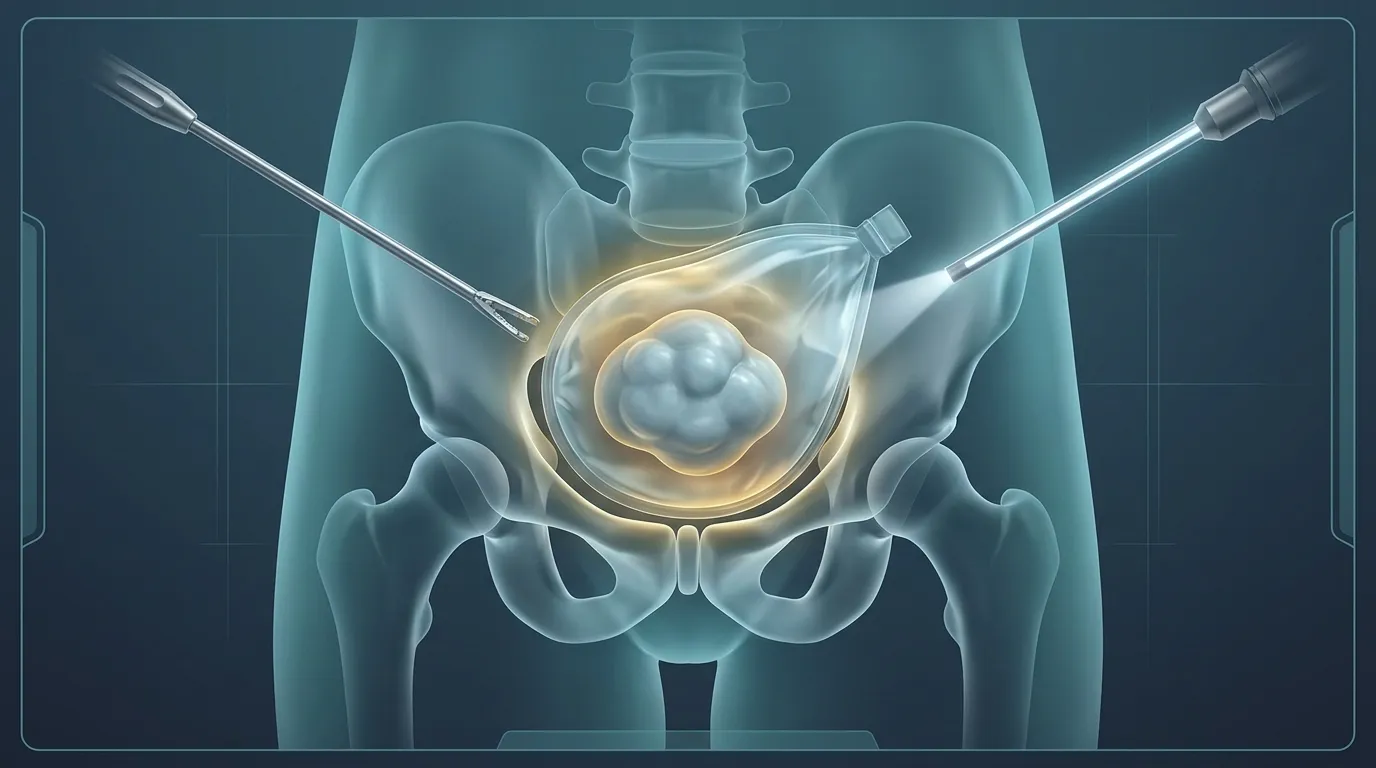
Recurrent and Ectopic Leiomyoma after Hysterectomy: The Critical Need for Cautious Laparoscopic Practice
While hysterectomy is generally curative for fibroids, a rare subset of patients develop recurrent myomas, parasitic myomas, or benign metastasizing leiomyoma (BML). Exploring the critical need for tissue containment, cautious laparoscopic practice, and balanced patient selection.
 Cancer Prevention
Public Health Priorities in India: IMR, NPAFP, Vaccine Sequencing & Cervical Cancer Screening
Examining India's infant mortality rate (IMR), Dr. Jacob Puliyel's NPAFP findings, Peter Aaby's BMJ/Lancet vaccine sequencing research, and the ₹1,300 crore annual HPV vaccine commitment versus India's 1-3% cervical cancer screening coverage.